

Search
Plumbing
Purchasing a Water Heater Thermocouple
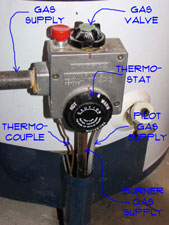 Purchasing a water heater thermocouple is going to involve a trip to the home supply store or some time on the internet. You have two choices when trying to purchase a thermocouple. One would be to find an original equipment part (OEM). The Second option (the likely option) would be to find a universal thermocouple that will fit your water heater.
Not sure if you need a new thermocouple? See the article 'Troubleshooting Gas Water Heaters' for more information and a coplete listing of all of the gas water heater topics. After you obtain a new thermocouple you will need to install it. See the articles 'Removing a Thermocouple Assembly' and 'Installing a New Thermocouple' for information and instructions.
The information below will help you to determine what information you need to purchase a new thermocouple that will work for your water heater.
Thermocouple or Thermopile Description
Simply put, the thermocouple or thermopile as they are sometimes called is a temperature sensor. For safety reasons, the gas valve will not allow gas to go to the manifold unless there is a flame at the pilot to ignite the gas.
A thermocouple uses two types of metal to create an electrical current that the gas valve can sense. If the electrical current is transmitted, it means that the end of the thermocouple is hot and there is a flame. Simple right? Don't go looking farther than this for an explanation, this stuff can get pretty techinical.
In practice, the thermocouple looks like a copper wire with a thick section that has a sensor end and an end with a fitting that goes into the gas valve. From an operational perspective the thermocouples for a water heater are all pretty much the same. However, there are two variables, the length and the fittings used to install them, see below.
A failing thermocouple will not send the correct electrical impulse and the gas valve will not release any gas. When this happens, you do not have hot water.
Thermocouple Part Numbers
Hunting up part numbers for water heaters can be a daunting task. First there are so many brands and models out there. Some of the better brands have websites that let you look up information, but as a rule, these websites are not do it yourself friendly. When it comes to specific information that is needed to make a repair, they are very vague.
You may think that looking in your manual and finding a part number is all that will be needed to solve your problem. Find the part number and order a replacemnet. The trouble is that most manuals do not list the individual part numbers for the thermocouple.
Instead, the parts diagram will show the entire manifold as a part. Replacing the whole manifold is an option, but why would you spend the extra money when all you need is the thermocouple or thermopile that costs less than ten dollars?
Some manufacturers do have 'name brand' thermocouples available. They may provide a manufacture date range or model range for which water heaters they can be used on. These will cost more as a rule and can be a reasonable option.
Universal Thermocouples
Universal thermocouples, as the name implies work on most water heaters. They are available online and in home supply stores for a reasonable cost. The length and the thread type are the two concerns when purchasing one.
Thermocouple Length
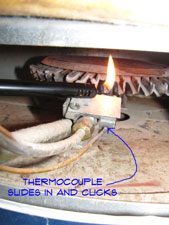 You are going to want to take the old thermocouple with you to get a replacement. A couple of things to watch for. You want to get one that is about the same length as the one you have. They are sold in in 6" increments for the shorter lengths, 18", 24", 30" and so on. For a water heater, 18" and 24" are common, although longer ones are possible.
Remove the old thermocouple and measure it to see what length you need. Try to get as close as you can to the original. You cannot cut them, bend or kink them, but you can coil them if needed. The length of does not affect how they work.
You may wind up with a thermocouple that is longer than the one you have. You can add a loop or two the make it work.
Thermocouple Thread Types
Left Hand or Right Hand Threads
Many gas valves have a left handed thread where the fitting for the thermocouple goes. You need to make sure which thread pattern you have before you order the new thermocouple. Don't plan on trying to make one work that is the wrong thread.
They make and adapters that will allow you to use a standard thermocouple on either a left hand or right hand fitting. A plumbing supply store should have the adapters available.
Adapter Kits
Most 'Universal' thermocouples include adapter kits along with the thermocouple. This is the best choice in most situation. The package will contain a few different fittings that can adapt to either left hand or right hand thread. Usually, thay also include a couple of different retaining clips for the sensor end of the device.
Thermocouple Cost
You can find 'universal' thermocouples on line for under ten dollars. Most of them include an adapter kit that allows you to install it on most water heaters.
You can pay upwards of fifty dollars for a 'name brand' thermocouple. These will not have adapter kits, so you need to make sure you are getting the right one for the make and model of the water heater you have.
Summary
Thermocouples are an inexpensive but important part on a water heater. If you have time, you can order them online. Keeping a spare handy is not a bad idea. You can also find 'Universal' replacement thermocouples at home supply stores.
With your new thermocouple in hand, you will need to install it. See the articles 'Removing a Thermocouple Assembly' and 'Installing a New Thermocouple' for information and instructions for this task.
Removing the Gas Burner Assembly
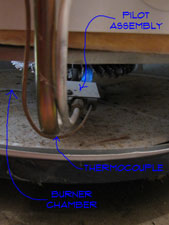 Removing the gas burner assembly is not too difficult. Remember, turn the gas supply off to the unit before proceeding with any work.
See 'Gas Hot Water Heater Troubleshooting' if this is not your problem. Is it just the pilot light? See the article 'Gas Water Heater Pilot Light' for lighting instructions.
The first thing you need to locate is the gas valve and the burner assembly. They are near the bottom of the tank. The gas valve has the main gas supply connected to it and three other pipes connected at the bottom of it.
The larger tube in the middle is the main gas supply. The smaller tube is the gas supply to the pilot light. The other copper looking wire or tube is the thermocouple
Older water heaters have a cover plate that just snaps on and off. Newer ones may have some screws to remove. The difference will be the electric igniter that is found on newer models.
The main gas supply comes into the side of the gas valve. There should be a vertical gas pipe that tees into it. You will find the shut off valve for the hot water heater on the vertical gas line. Before you do anything, shut off the gas.
When the handle to the valve is perpendicular to the pipe, the gas is off. When it is parallel, the gas is on. Simple right? Look at the picture and make sure the gas is off.
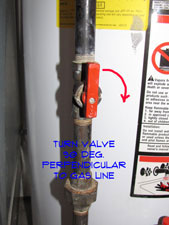 Then using open end or adjustable wrenches you can loosen the connections below the gas valve. First loosen the thermocouple fitting. There are some gas water heater thermocouples that are threaded left hand. When it won't loosen try going the other way.
Next to remove would be the pilot light supply line. This should turn the normal way. Last unhook the main gas supply. Remove the wire that goes to the igniter if you have one for you hot water tank.
At this point the burner assembly should be free. Remove it from the chamber. The thermocouple might be threaded through the tubing for the gas lines. If it is bent in a special way you will want to preserve this to serve as a model for the new one. Pull the thermocouple out of the pilot assembly.
WARNING!! Natural Gas Can Explode! Make Sure the Gas Is OFF Before Working On Your Water Heater!!! WARNING!!!
With the burner assembly out of the way it is a good time to do some maintenance. Get a small brush on a long handle the clean the debris up off the bottom of the chamber. Use a vacuum cleaner to suck up the loose material.
Replacing a gas water heater thermocouple provides the ideal circumstances for a clean up and maintenance job. Dirt and debris build up over time that can interfere with the proper functioning of the burner.
Another task you can do when the burner out is to 'Replace the Thermocouple'.
Gas Hot Water Heater Troubleshooting
This article on gas hot water heater troubleshooting will help you to locate your problem and get it repaired quickly. See below for guidelines on what to look for and information on how to fix it. Don't have a gas water heater? See 'Fixing Electric Water Heaters'. Not sure which kind you have, see 'Identifying Water Heater Types', for a description of each type.
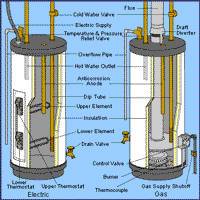
There are two key topics associated with 'Gas Hot Water Heaters'. (1) 'Water Heater Pilot Light Issues' - If the pilot light goes out, the water heater won't work. (2) 'Problems With a Gas Water Heater Thermocouple' - A bigger problem than just lighting the pilot.
Some common problems for all types of Hot Water Heaters are, pressure relief valves, leaks, sediment, drain valves, anode rods and dip tubes. A general troubleshooting discussion is provide in the article, 'Identifying and Repairing Water Heater Problems'.
The danger with a gas hot water heater is the gas itself. If for some reason gas is allowed to escape without being ignited, you can get an explosive situation. Gas has an odor to it that you are probably familiar with. The odor is added as a safety feature. 'I smell gas', something you hear or say from time to time is not from smelling the gas at all. Natural gas is odorless. A chemical is added to alert people to a gas build up.
Natural gas can explode. Caution needs to be exercised to make sure the gas is shut off and only turned on when the pilot is lit. Some repairs that result from gas hot water heater troubleshooting are fairly simple. Others may require some work.
Gas Hot Water Heater Repairs & Replacement - Costs Involved
We are in the whitewater of cost potential here. A new hot water heating unit can run anywhere from $350 to $3,500. Installation costs can run from $200 to $1,600. This is all for a new system. Yes, you may only need a $20 part. Add that to a service call and you should be looking at $100, more or less. Although repair bills of several hundred dollars are not unheard of. Just keep in mind that with the potential above you might get some serious selling when you try to get someone to fix your hot water heater.
Natural Gas Safety Concerns
Remember there is a potential danger with the gas. Natural and propane gas can explode. Never attempt a repair unless you have turned the gas off and are thoroughly familiar with safe working practices.
WARNING!! Natural Gas Can Explode! Make Sure the Gas Is OFF!!! The Hot Water Can Be VERY HOT!!! WARNING!!!
A gas leak is an entirely different problem than a broken water heater. If you smell gas, take immediate safety precautions, which include leaving the premises and calling the gas company. See the article 'Natural Gas Safety Tips' for more information.
Gas Hot Water Heater Troubleshooting Information
Take a look at the possible problems below. Try to find a match for your situation. Follow the links to get to the right information. Read through that information before you proceed. Many problems can have more than one cause.
 No Hot Water
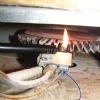
Check the pilot light. Is it on? The thermocouple provides a safety feature for a gas hot water tank. When the pilot is not on, the valve will not allow any gas to be delivered. See the article 'Hot Water Heater Pilot Light', for the information on what to do .
Did you check to see if the gas is on? Go to the article 'Hot Water Heater Gas Valve', for direction on issues with the gas valve.
 Not Enough Hot Water
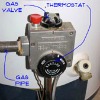
This gas hot water heater troubleshooting exercise starts with the thermostat. Go to 'Gas Hot Water Heater Thermostats' for a discussion.
A clogged flue or vent could be the problem. See 'Venting a Gas Water Heater' for information on keeping your vent clear. A defective thermostat is also possible.
The thermostat is part of the gas valve. See 'Water Heater Gas Valve Problems' for the issues surrounding this device.
The dip tube is another possibility. The article 'Hot Water Heater Dip Tube' addresses this problem.
 Pilot Will Not Light
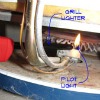
You need to follow the correct procedure to light the pilot. See 'Problems with Gas Water Heater Pilot Lights' for instructions.
Gas hot water heater troubleshooting usually leads you to the thermocouple. Go to the article 'Gas Water Heater Thermocouple Issues' for information on this common repair.
The other less common problem would be the gas valve. A bad gas valve will not allow any gas to go to the burner or pilot light. See 'Fixing Hot Water Heater Gas Valves' for the issues surrounding this device.
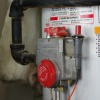 Pilot Will Not Stay Lit
The thermocouple is usually the problem when this happens. Go to the article 'Gas Water Heater Thermocouple Issues' for information on this common repair. The other less common problem would be the gas valve.
A bad gas valve will not allow any gas to go to the burner or pilot light. If the pilot light lights and then shuts off it is not the gas valve. If it won't light at all, see the article, 'Fixing Hot Water Heater Gas Valves' for the issues surrounding this device.
A clogged or partially clogged vent can also cause this problem. See 'Gas Water Heater Vents'for information on keeping your vent clear.
 Water Too Hot
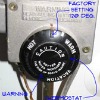
The first thing to check is the thermostat. Go to 'Gas Hot Water Heater Thermostats' for a discussion. If it is set too high, it may just need an adjustment.
The thermostat needs to be set to a safe temperature. Scalding and severe burns can occur in a matter of seconds when the water temperature is too high. Most manufacturers reccommend a setting of 120 degrees. See the article 'Proper Water Heater Temperature Settings' for safe guidelines on hot water settings.
A defective thermostat is also possible. The thermostat is part of thegas valve. See 'Hot Water Heater Gas Valve' for information on what can be done.
 Main Burner Will Not Stay Lit
Again the thermocouple could be at fault. If the thermocouple is faulty, it will not send the correct signal to the gas valve to allow gas to continue flowing. Go to the article on 'Gas Water Heater Thermocouples' for information on this common repair. The other less common problem would be the gas valve.
A bad gas valve will not allow any gas to go to the burner or pilot light. See the article on 'Hot Water Heater Gas Valves' for the issues surrounding this device.
A clogged or partially clogged vent can cause this problem. See 'Venting a Gas Water Heater' for information on keeping your vent clear.
 Black or Rusty Colored Water
This is caused by a dissolved anode. The anode rod has metal in it that is supposed to oxidize in place of the steel in your tank. This prevents your tank from leaking. When the metal is gone the steel core and your tank start to rust, thus discoloring the water. See 'Hot Water Heater Anode Rods' for information on the anode rod.
Sediment in the tank can also discolor the water. Over time the minerals in the water will build up inside the tank and some of them can oxidize, thus causing a dark color and odor. See the article 'Water Heater Sediment' and 'Flushing a Hot Water Tank' for more information.
 Slow Recovery Time
A clogged or partially clogged vent can cause this problem. See 'Venting a Gas Water Heater' for information on keeping your vent clear. If the vent is clogged or partially clogged the burner may not be working efficiently.
Another problem is the size of the hot water tank. Do you have more people in the house, perhaps visiting? The water heater may be too small for the demand. See the article 'Water Heater Sizes for Households'.
You may be tempted to turn up the temperature on you water tank, however, this can be dangerous. See the article 'Water Heater Temperature Settings' for instructions.
 Pressure Relief Valve Leaking
The pressure relief valve very rarely leaks in the true sense of the word. It does however vent water which can seem like a leak. The water will vent for two reasons, one is that the pressure in the tank is too high, this should be addressed as soon as possible. Issues with this item are found in the article, 'Checking Pressure Relief Valves'.
The other reason would be a defective valve that vents even when there is not a problem. When the valve goes bad, it will have fail to the open posistion. This type of valve has a useful lifespan that is shorter than other types of valves. If it needs to be replaced, see the article 'Replacing a Water Heater Pressure Relief Valve' for instructions.
 Hot Water Tank is Leaking
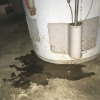
Depending on the location of the leak, this might be a big problem. There are four possible spots that the water heater can leak, the water lines, the pressure relief valve, the drain valve and the tank itself. Go to the article 'Repairing a Leaking Hot Water Heater' to track down your problem.
WARNING!! Natural Gas Can BE Dangerous!!! The Water In Your Tank Can Be VERY HOT!!! WARNING!!!
Water on the floor around the water heater may be caused by leaks in the pipes connected to the water heater or by the pressure relief valve. See the article 'Checking a Water Heater Pressure Relief Valve' and 'Checking for Plumbing Pipe Leaks' for more information.
Gas Hot Water Heater Troubleshooting - Article Topics
 Gas Hot Water Heater Pilot Light
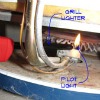
Gas hot water heater troubleshooting always seems to start with the pilot light. Most gas hot water heaters us a pilot light to ignite the burner. There are some more expensive models that use electronic ignition.
When the pilot light is out or won't stay on, you will not have hot water.
Follow the above link to get to an article that discusses the issues related to the pilot light. Find out if this is the type of repair you can do yourself?
 Gas Water Heater Thermocouple
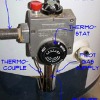
The thermocouple is a sensor that tells the gas valve when to allow gas to flow to the burner. Gas hot water heater troubleshooting often involves the thermocouple.
When they go bad the will not allow the gas valve to release any gas. No gas, no hot water.
Follow the above link to get to an article that discusses the hot water heater thermocouple. This is a common do it yourself repair that you will probably be willing to attempt.
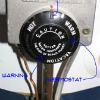 Gas Water Heater Thermostat
The main concern with the thermostat is getting the temperature set right. Water that is too hot can be dangerous. Learn what the proper settings are.
The gas valves and thermostats are slightly different on various models of hot water heaters. There is a procedure that needs to be followed when making changes. Often, this is printed on the side of the water heater.
The thermostat is part of the gas valve. There is not a lot that can be done to fix one that is bad, short of replacing the gas valve.
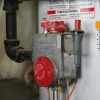 Hot Water Heater Gas Valve
The gas valve controls the gas that goes both to the pilot light and the main burner. It uses the thermocouple to determine when it is safe to release the gas. It also uses an integral thermostat to know when more heat is needed. Explosions can result from natural gas that is not burned. Therefore the water heater gas valve has safety devices built in.
Gas valves are a fairly expensive part and are quite a bit of work to change. Is yours really bad? Find out by following the above link. Make sure you have finished your gas hot water heater troubleshooting exercise before you assume it is the gas valve.
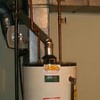
Obstructions in the vent pipe can restrict the air flow to your water heater. This will cause the burner to operate poorly. It could mean a reduced amount of hot water. Badly clogged vents will result in dangerous gases building up in the home.
There are two types of vents for gas hot water heaters. For standard efficiency models there is a 'Hot' vent that is connected to a chimney. High efficiency models will have a plastic vent that may go horizontally out of of the house. Either type can become clogged.
Additionally, the chimney that the vent is attached to, can be clogged.
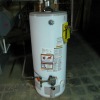 Installing a Gas Hot Water Heater
When all else fails you may be faced with replacing your hot water heater. At this point you will have to decide if you are up to the task of replacing the water heater yourself.
The first hurdle will be deciding what type of water heater to purchase.
If you can get some help, you may want to consider it. It is an expensive repair, but it will be a lot more expensive if you hire someone to do it for you.
Problems Common to All Water Heaters
 Dealing With Hot Water Heater Sediment
Sediment can build up in the bottom of your hot water heater over time. This can affect the amount of hot water you have and potentially damage other components. Minerals in the water, even city water can build up over the life of the water heater.
These deposits can significantly lower the amount of available hot water. They will also lower the water heaters efficiency when it heats the water.
There are steps you can take to remove the sediment. Learn what they are by following this link.
Learn what you need to do to get rid of the sediment inside your hot water tank. It can be a little messy, but it will get you hot water tank working the way it is supposed to. A garden hose and a pair of pliers is all you need. Click on the link above to get to the information.
Repairing a Leaking Hot Water Heater
How serious is it when a hot water heater is leaking? That depends a lot on where it is leaking and how much. Some things can be tightened to stop the leaks. A tank that is leaking is not good news.
Find out if you need to look through your papers for the warranty. See if this is something you can fix. Click this link to get the good or not so good news.
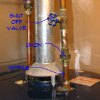 Repairing a Water Heater Dip Tube
What's a dip tube anyway? Believe it or not, it is an important feature of your hot water tank. Cold water that enters the tank needs to be pushed to the bottom of the tank, otherwise it will cool the hot water that is already in the tank.
Find out what can go wrong with this part and what you need to do to fix it. Just take my word for it, it is important.
The amount of hot water you have will be affected by it, when it is broken. Follow this link for information.
 Repairing a Water Heater Pressure Relief Valve
The name tells you everything. When pressure builds up inside your hot water tank, this valve releases. This is a safety feature. A defective valve will release when the pressure is still within safe limits. How to you know when it is bad? How hard is it to fix?
Click on the link above to find answers to these questions. Can you replace this valve if you need to? How hard is it? More questions that this article answers.
Gas Hot Water Heater Troubleshooting Summary
There are several possible problems you can be having with your gas hot water tank. Sorry, but there are more issues than one article can cover. We have tried to point you in the right direction for finding the answer to your problem. Some of the answers to your problem may be more than you want to tackle. On the other hand, some repairs are not that hard.
You be the judge. Gas hot water heater troubleshooting involves some problems that are fairly simple. Hopefully, even if you wind up calling a technician, you will be able to discuss the problem with him intelligently. Asking the right question will often save you money.
Gas Water Heater Thermocouple
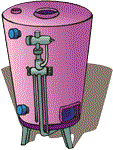 The gas water heater thermocouple is a safety device. It senses when the pilot light is on. When the pilot is not lit the gas valve will not turn the gas on. Make sure the problem is not your 'Water Heater Pilot LIght', before you attempt this repair.
You could be looking at an hour to change it and ten or fifteen dollars for the part. The thermocouple is made of two different metals that are bonded together.
There are (3) key things related to the thermocouple. 'Purchasing a Thermocouple', you can get generic ones that fit most water heaters at a hardware store. 'Removing the Burner Assembly', you will have to take the burner assembly out to change the thermocouple. Installing a Water Heater Themocouple', With the burner assembly removed, installing the thermocouple is fairly easy.
How a Thermocouple Works
A thermocouple is basically a sensor that sends an electronic signal to the gas valve. The interesting thing is that this sensor does not use electricity to work. Instead it uses the heat from the pilot light to generate the electrical impulse that is sent to the gas valve.
The end of the thermocouple is situated in the pilot light. As long as the pilot light is lit the gas valve senses it via the thermocouple. With the pilot light lit the gas valve will let gas go to the burner.
When the thermocouple starts to fail it will send the wrong signals to the gas valve. The gas valve 'thinking' that the pilot light is out will shut off the gas. The burner won't light and the pilot light will go out. The translation of that is 'NO HOT WATER'. This is usually where the complaining starts. See what you need to do to correct this by reading on.
Gas Water Heater Thermocouple - Information
What Can You Save?
The part is less than $20. It is a little bit of work to replace it. You will probably be looking at $100 to $125 in labor. This is assuming that you don't get talked into a new water heater. A new water heater can run $800 to $1,500 installed, depending on the type.
How Hard Could It Be?
Repairing a gas water heater thermocouple usually means that it needs to be replaced. You have to unhook the piping from the manifold and shut down the hot water tank. No draining for this repair.
Check the Simple Things!
Try the pilot light first. If you have gotten to this article you have probably already tried.
What Can Go Wrong?
The hot water heater will not work with a bad gas water heater thermocouple. Not getting it back together or getting it installed incorrectly will leave you without hot water. You are also dealing with natural gas. Make sure the gas is turned off before you attempt any repairs. Gas can explode, make sure the valve is in the off position before you unhook anything.
Troubleshooting a Water Heater Thermocouple
The thermoucouple is a simple replaceable part on your hot water heater. If it is not behaving as it should, replacing it is the only option. There are no adjustments or parts that can be repaired or replaced.
If you have a pilot light that will not stay lit or a burner that will not ignite, the thermocouple is the likely culprit.
Purchasing a Thermocouple
There are universal thermocouples that will fit most water heaters, the length is the critical feature. You will need to measure the one that you have to determine what size you need. You can find a complete explanation in the topic, 'How To Purchase a Water Heater Thermocouple'.
Removing the Manifold
For an older water heater, it is likely that you will need to remove the burner assembly to free up the thermocouple before removing. For instructions see the article on 'How To Remove a Water Heater Burner Assembly'.
Installing a Water Heater Thermocouple
Once the old thermocouple is removed and you have a new one in hand, all you have to do is install it. This is discussed in the article 'How To Install a Thermocouple'.
Gas Hot Water Heater Installation
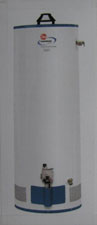 A gas hot water heater installation is needed when your old water heater has gone to a better place. Are you sure your water heater needs to be replaced? Have you checked on possibly fixing it? Water heaters can last ten to fifteen years. Is yours older than that? Installing a new gas water heater is a big job for a homeowner. Yes it can be done in a day if things go well.
Before you decide on a new gas hot water heater installation you want to make sure you can't repair the one you have. See the article Gas Hot Water Heater Troubleshooting for things you can check on.
This article covers the installation of a standard, normal draft gas hot water heater. These are the lowest cost to purchase and the easiest to install. On demand, high efficiency or induced draft units are not covered in this article. Feel like you are in the right place? Then read on.
Using Common Sense Header
What Can You Save?
A standard 40 gallon gas hot water heater installation should run between $800 and $1,000. Size matters and so does the age of your current installation. An installer may tell you need other parts and this will drive the cost up. Sometimes another $200 to $500 of up selling can take place.
How Hard Could It Be?
A gas hot water heater installation is a fairly difficult job and will take most of a day if all goes well.
For and explanation of the terms in this section, see How to Use This Site.
Check the Simple Things!
There is nothing simple about installing a new water heater. Check out the article Gas Hot Water Heater Troubleshooting, to make sure the water heater is really a goner.
What Can Go Wrong?
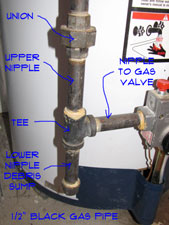 A gas hot water heater installation is a big job. It involves natural gas and gas can explode. Make sure the gas is off and the area is well ventilated. The water in your tank will be hot if the heater is working. Cool it down before you try and drain it. Size does matter, and getting a water heater that is a different size that the one you had will require that the hook ups be modified. Not getting the job done will leave you without hot water. Not a savory thought.
Selecting a New Hot Water Heater
Gas hot water heaters come in different sizes. Getting one with that is the same height will make a huge differences on how hard the hook ups are going to be. There are some key dimensions. One is the height of the top of the water tank from the floor. The second would be the height of the gas supply line from the floor. It is not the end of the world if you can't find an exact match. It just means that you will have to modify the piping. Another consideration would be the vent pipe. Most water heaters have 3" vent pipe. You cannot reduce the vent pipe so getting a new heater with a larger vent is a problem.
The next concern is the cost. Gas hot water heaters can range in cost from around $300 on up to $2,000 for a high efficiency model. In this article we will make the assumption that you are going for a less expensive standard model. These should be in the $300 to $600 range.
Watch where you buy your hot water tank. Some online vendors and specialty stores have disclaimers that void the warranty if you install the hot water heater yourself. The home supply stores that cater to do it yourself customers, have warranties without this disclaimer. Obviously they exclude improper installation and incorrect usage.
Water heaters are a big item and will not fit in the trunk of a car. In addition they are glass lined and should be handled with caution.
Some ancillary items that you might need would be: (1) Dielectric unions or nipples. Some water tanks come with these installed. You will have to check with your building department to find out if these are required. (2) Pressure relief valve. Some new water heaters have them pre-installed, others do not. A drip pan, these are suggested and required in some places. A stand if the water heater is going in the garage. The bottom of the water heater needs to be 18" off the ground in a garage. You may also need misc. fittings to make the connections.
WARNING!! Natural Gas Can Explode! Make Sure the Gas Is OFF!!! The Hot Water Can Be VERY HOT!!! WARNING!!!
Removing the Old Water Heater.
Removing your old hot water heater is part of a gas hot water heater installation. The first thing you want to do is turn off the gas to the water heater. You should have a shut off valve in the gas line near the connection to the gas valve. You turn the valve ninety degrees until it is perpendicular to the gas line. Next run some hot water in a sink nearby until the water cools down (if the water heater is not working you can skip this step).Shut off the cold water inlet valve and leave the hot water faucet open in sink nearby. Hook a garden hose up to the drain valve near the bottom of the tank. Run the hose to a floor drain or outside and open the valve. After it has drained down a little way, you can open the pressure relief valve and shut off the faucet.
At this point you can unhook the gas line. You should have a union below the shut off valve. Use pipe wrenches to loosen it. You want to hang onto the nipples and fittings that are connected to the hot water tank. Remove and save everything up to the gas valve.
Next would be the water lines. The cold water inlet and the hot water outlet. Again you should have unions not to far above the tank. Loosen the unions with two pipe wrenches. Unhook the first section of vent pipe from the fume hood and the first fitting. Save this piece also. At this point the tank should be free.
You should remove the fittings and nipples at the top of the tank as long as they are in good condition. One more item you will want to salvage is the drain tube that extends down from the pressure relief valve.
This is where you need the helper. Get some help to remove the old tank. Disposing of it might be a chore in itself. For now you want to get it out of the way.
Placing the New Water Tank
The next step in a gas hot water heater installation is unpacking the new unit. It is best to do this out away from the area it is being installed. There should be some instructions that come with it. Read through the instructions and look for any special items that need to be attended to. Be aware of any temporary plugs or shipping braces that need to be removed.
Are you installing a drip pan. Put in place before you try to set the water tank. Using some help again carry the new water tank into the location and set it in position. Turn the tank so that it is oriented the same as the old one. The hot and cold water lines and the gas line all need to line up.
At this point you find out how much trouble you are going to have with the fittings. Try dry fitting the gas line parts from the old water tank. Do they line up? Yes, great, this is good news. No, Take some measurements. Remember to allow 3/8" to 1/2" of additional length for each threaded end. You might want to make a sketch of what you will need.
Now check out the water line nipples. Are adjustments needed. For a tank that has dielectric nipples installed you will need a coupler and possibly a reducer. The nipple length may be off. Measure from the inlet and outlet on the water tank up to the bottom of the union. Make yourself a little sketch with the dimensions. You may have flexible connections here. Some building departments allow it. If you do that is a lot easier.
Mark your sketch with the fitting types, male, female and union and to what point on the fitting you are measuring to. Oh, almost forgot, size of pipe, either 1/2" or 3/4" or a combination of the two. I know this is a little tedious, but it is a necessary step in a gas hot water heater installation.
Last you want to put the new fume hood in place on top of the tank. How does your vent pipe line up. Is the old piece long enough and the right size? Yes? Good news. No, then you will have to get another piece of vent pipe.
Are you ready for a trip to the supply house? Take your sketches with you and go to a home supply store that does pipe threading and has a plumbing department. Ask for help and explain your situation. They should be able to cut and thread the pipe for a nominal sum. In addition they can get you the right fittings to make the connections. Get some suitable joint compound while you are there.
Installing the Gas Line
With the right fittings in hand this step of your gas hot water heater installation should not be hard at all. You use pipe wrenches to tighten gas line. You want to use a joint compound on the threads that is suitable for gas connections. Start with the nipple going into the gas valve. Remove the plastic cap first. Tighten the fitting snug. Put the tee on next and then the upper and lower nipples. The lower nipple should have a cap on it. The upper nipple goes into the union.Make sure all the connections are tight and then tighten the union. Turn the knob on the gas valve to off. You can turn the gas on at this point. Use soapy water to check for leaks. Never use an open flame to check for gas leaks. Find a leak, you know the drill, take it apart and tighten it.
Hooking up the Water Lines
Water line hook up in a gas hot water heater installation is e lot easier when you have the right fittings. Again you should use pipe joint compound on the threaded connections. Be sure to remove the plastic caps. Work from the water tank up toward the unions when tightening things. Make sure the connections are tight. Hook up the unions and that should be it.
Then last item would be the pressure relief valve. Again use some pipe joint compound on the threaded connections. Tighten the relief valve with the outlet turned down. Install the outlet tube that you took off the old unit.
Hooking Up the Vent
Did you listen and get a water heater with the same size vent? Good, your gas hot water heater installation is a lot simpler! You will have to replace all the vent pipe up to the chimney if you got one with a larger diameter.
Install the fume hood on then top of the tank. The fume hood should set level and the legs should be straight. There should be some holes for the legs. Get the legs in place and hold down on the fume hood. You want to run some sheet metal screws down into the holes next to the tabs on the legs.
Cut your vent pipe to length, remembering the parts that slip over. Screw the vent pipe into place using sheet metal screws.
Starting it Up
You have to fill the hot water tank before you can turn on the burner. Open a hot water faucet nearby and turn on the water. Let the tank fill until all of the air is bled out of the tank.
Check for leaks and tighten anything that is leaking. Read the instructions for lighting the pilot. Every water heater varies slightly on this procedure. With the pilot lit you should be able to turn the gas valve to on and the heating process will begin. A hot shower is not too far in the future.
Gas Hot Water Heater Installation Summary
Now that was a big job. You might be a little tired, but you likely saved $300 to $500 doing the work yourself. Was it worth it? You will have to be the judge of that. I have heard horror stories of homeowners that were sold hundreds of dollars of additional parts when the plumber came out to actually install the heater. You may have saved even more.
With this experience under your belt you are ready to tackle just about any home repair project. What will you do now? For today a little rest is in order. Tomorrow, who knows.